
How to Create Family Routines That Actually Work
This post contains paid links. As an Amazon Associate I earn from qualifying purchases.
A morning routine can look wonderful on paper and still fall apart over one missing shoe. If your family has tried a detailed schedule that lasted three days, you may wonder whether routines are worth the effort.
They can be, especially when you build them around the life you are already living. A useful routine tells everyone what comes next and leaves room for interruptions. You can begin with one part of the day that needs a little more support.
Illustrative lifestyle image created for The Rooted Home Journal.
In this guide
What makes a routine workable
Choose one daily anchor
Make the steps visible
Share responsibilities
Test and adjust
Common questions
What is a family routine?
A routine is a familiar sequence linked to a repeated part of your day. After breakfast, dishes go to the kitchen and bags move to the door. Before bed, tomorrow’s essentials are checked and the lights begin to dim.
A schedule assigns times. A routine can follow an event, which is helpful when family days vary. You may eat dinner at different times while still following it with the same short kitchen reset.
Begin with the sticking point
Choose a moment that repeatedly feels difficult. Be specific: leaving the house, finding school paperwork, deciding dinner, or gathering toys before bedtime. “Get organized” is too broad to guide the next step.
For example, if departures are hard because belongings are scattered, start with an evening bag check and one place for shoes. You may not need to change the rest of the morning at all.
The American Academy of Pediatrics’ family routines guide offers useful background on everyday household rhythms. Your version can reflect your children’s needs, your work patterns, and the help available.
Choose one reliable anchor
Connect the new routine to something that already happens. “After lunch” may be easier to remember than an extra alarm. “Before we start the bedtime story” can give toy pickup a clear place.
Pick an anchor you can recognize even on an unusual day. If evenings vary because of shifts or activities, use “when we arrive home” or “after our last meal” rather than relying on a fixed clock time.
Write three clear steps
Describe actions people can see
Try “put your cup by the sink, place shoes in the basket, and bring your bag to the door.” These actions are easier to explain and check than “be ready for tomorrow.” Keep the list short while the routine is new.
Define what finished looks like
If a job involves a shared space, agree on the finish together. A kitchen reset might mean dishes gathered, food put away appropriately, and one counter cleared. The rest can belong to a different cleaning session.
Use a visible reminder
A short written list or a few simple pictures can help people remember the order. Put it where the routine happens. If you need to walk to another room to read the instructions, the reminder may be easy to overlook.
Share the routine realistically
Demonstrate child-sized jobs and practice them together. A young child may return a few books while an adult handles the rest of the room. Another adult can own a whole step, such as checking the school calendar and preparing the required items.
Do not assume that a posted list settles responsibility. Agree on who does what and how the task will be handed over if that person is unavailable. Adults should remain responsible for the family calendar and essential preparation.
Create a smaller version
A routine needs a version for the evening when everyone is tired. If the normal sequence includes a kitchen tidy, bag check, and laundry step, the minimum might be food put away and tomorrow’s bag ready.
Write down that smaller version before you need it. It gives the household a clear decision when energy is low and helps the routine survive a demanding week.
Try it for a week, then review
Ask what helped and what caused friction. Perhaps the shoe basket is too small. Perhaps toy pickup happens when the children are already exhausted. Change the setup or timing before deciding the whole idea failed.
Use your weekly review to make one adjustment. Our Free Printables page brings the weekly reset and other planning tools together, so you can keep the routine connected to the wider week.
A sample after-dinner routine
One adult puts food away and handles dishes. Another helps the children return toys and check bags. Everyone puts their own shoes in the landing spot. After that, the family moves into its usual evening activities.
Your household may divide the jobs differently. The useful elements are a clear anchor, a short sequence, agreed ownership, and a finish that does not keep expanding.
To make those agreed steps visible, try the Family Evening Preparation Plan in Little Routines, Big Relief — Family Routine Bundle. You could write “put food away,” “return toys,” and “check bags,” then use the blank version to adapt the sequence to your household. The bundle also includes morning and after-school routine pages, so you can work on one transition now and save the others for later.
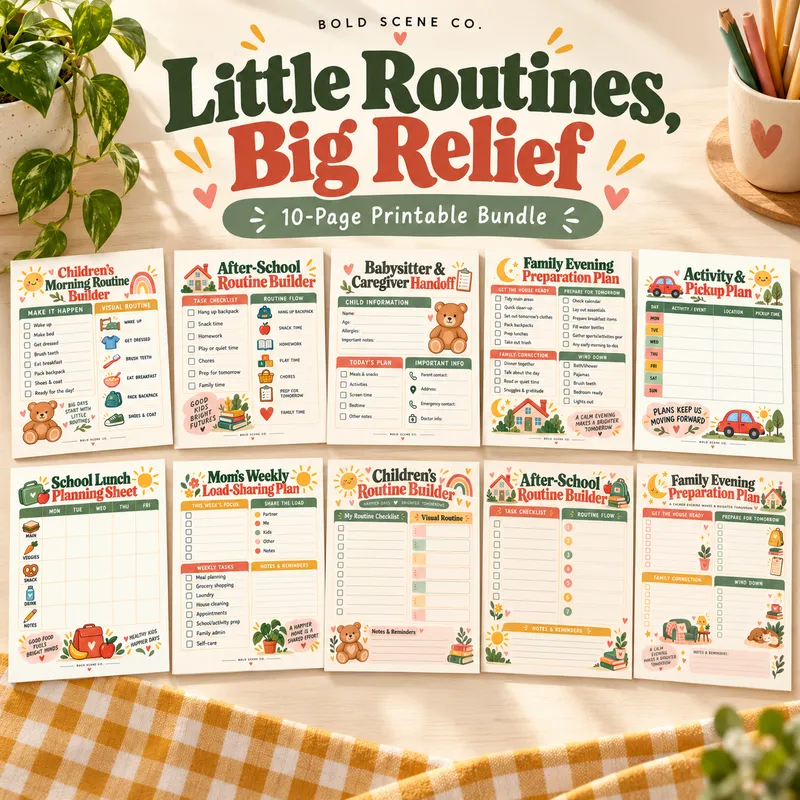
Printable PDF download for personal and family use. No physical item will be shipped. Accessories shown are for display only.
Common questions
How many routines should we begin with?
Start with one. Once it becomes easier to follow, decide whether another part of the day needs support. Several new routines at once can be difficult to practice consistently.
What if a child resists?
Check whether the step is clear and manageable, then help them begin. Offer a limited choice where it fits, such as putting books or blocks away first. Adjust expectations to the child and the situation.
Can routines work with an unpredictable schedule?
Try event-based anchors and a small minimum version. The sequence can stay familiar even when the time changes. Review it as your family’s circumstances change.
Use a timer you already own to give a short reset a clear stopping point. If a visible countdown would make that time limit easier to share, the TIME TIMER Home MOD visual timer (paid link) is an optional tool to compare.
A quick visual guide
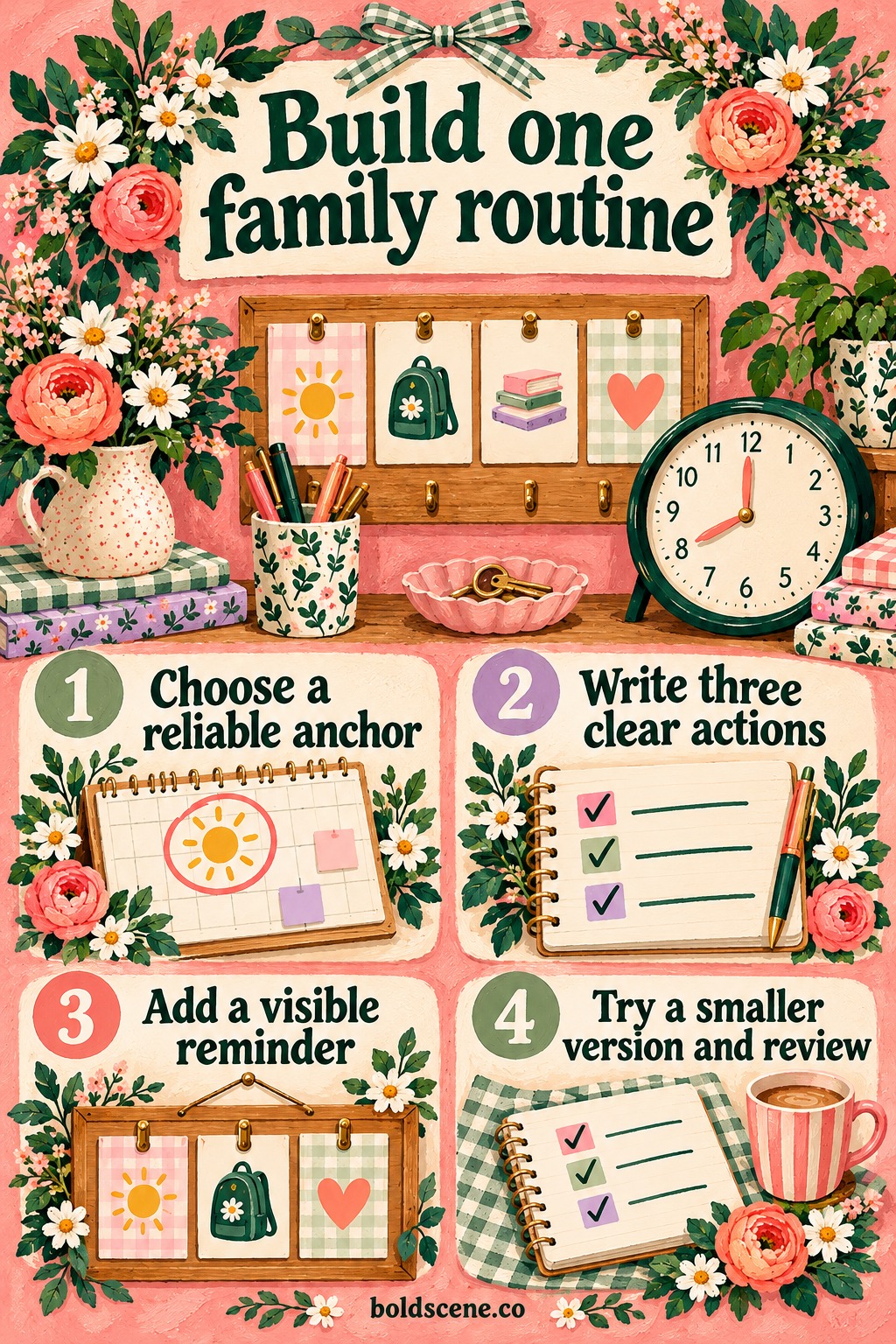
Build a rhythm you can return to
Choose one moment, keep the steps visible, and practice together. A workable routine gives your family a dependable next step while leaving room for real life.
Get the free Preschool Morning Routine Chart for a picture reminder you can practice together. Choose the steps that fit your child, add your own, and keep it where your morning routine happens.