
How to Build a Simple Home Management System
A school message arrives while you are making lunch. You remember a household supply you need while putting away laundry. An appointment card lands in your bag, and by evening you are trying to remember where every detail went.
A home management system gives recurring information a dependable home. You can build one with a calendar, a few lists, and a short weekly review. The best starting point is the part of family life you keep having to remember twice.

Illustrative lifestyle image created for The Rooted Home Journal.
In this guide
What a home management system includes
Choose one main hub
Set up calendar, meals, and household tasks
Keep important information accessible
Review and share the system
Common questions
What is a home management system?
It is the way your household captures information, makes plans, and follows through. A binder can be part of it, but so can a shared calendar and a sheet on the fridge. The format matters less than whether the people using it can find the next step.
A system has three useful jobs: collect what comes in, show what needs doing, and keep information available when needed. Begin with those jobs before choosing dividers or designing lots of pages.
Choose one main hub
Pick the place your family already checks. A kitchen calendar may be useful for visible dates; a shared digital calendar may work better for adults on different schedules. Avoid keeping two separate versions that need constant copying.
For paper that needs action, choose a tray or folder. Make it clear what belongs there: school forms, appointment details, or a bill that needs handling. Give finished papers a separate destination so the action folder stays meaningful.
Build four simple sections
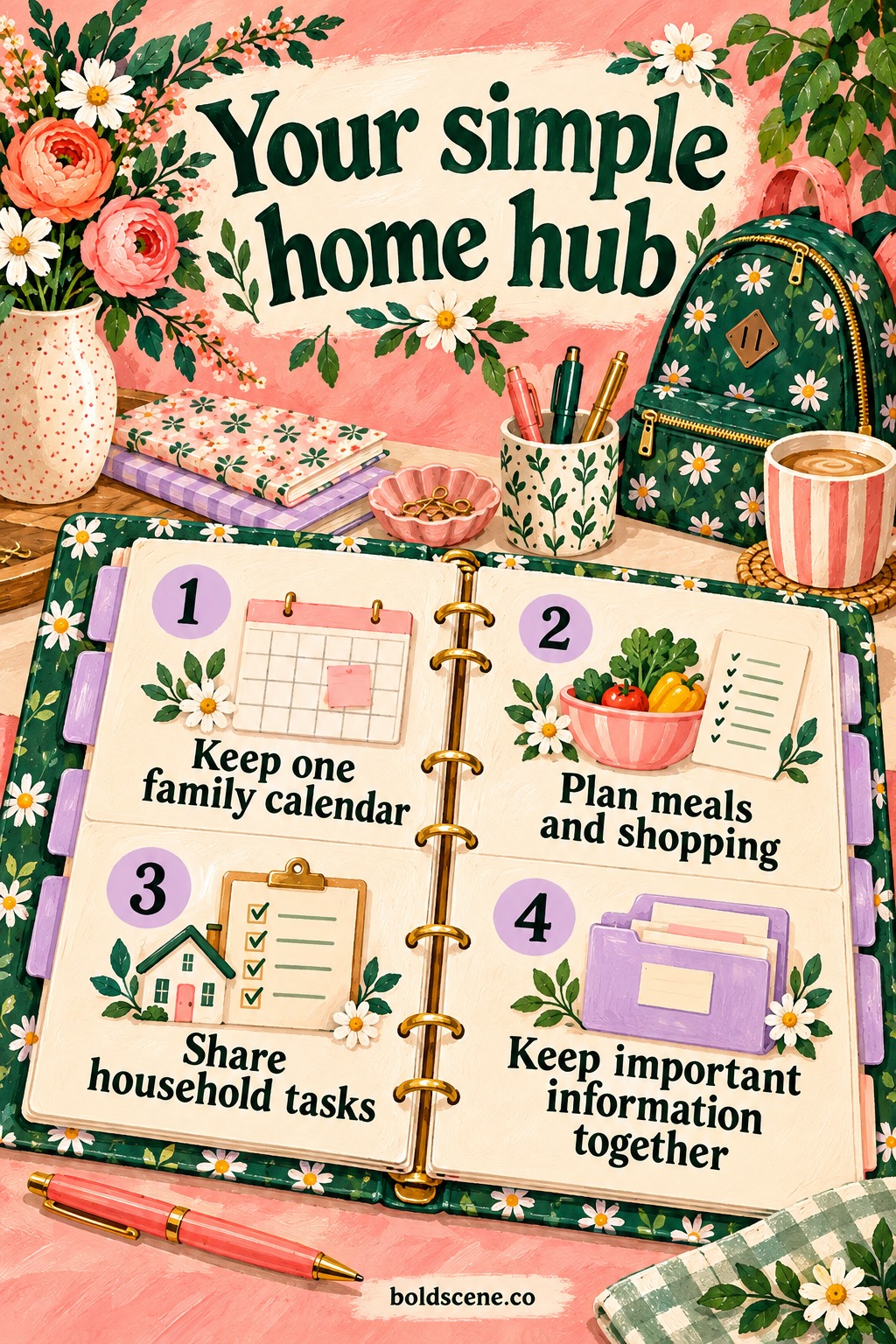
1. The family calendar
Capture fixed commitments and the practical details around them. Include who is responsible, where to go, and anything that needs preparing. A note that says “return library books Friday” is more useful when the books also have a place by the door.
2. Meals and shopping
Keep a small list of household favorites, the current meal plan, and a running grocery list. Review them together before shopping. The meal plan should reflect busy days already on the calendar.
3. Household tasks
List the recurring jobs that matter in your home. Separate daily basics from weekly or occasional work. You can start with dishes, laundry, rubbish, and a few frequently used spaces rather than a detailed schedule for every cupboard.
4. Important information
Keep the details your household needs to retrieve: school contacts, appliance information, or a note about where essential documents are stored. Protect private information appropriately. A public family noticeboard is a poor place for passwords, account numbers, or sensitive records.
Make tasks specific enough to share
“Do school prep” may mean different things to two people. “Check the folder, sign forms, and place the bag by the door” shows the finish. Agree on what belongs to each person and when it needs completing.
For children, choose a concrete job and demonstrate it. The American Academy of Pediatrics’ chore guide offers a useful reference for family responsibilities. Keep adult coordination with the adults while giving children supported ways to participate.
Give the system a weekly appointment
Choose a short review when you can look at the coming week. Clear completed items, transfer new dates, choose three priorities, and check the meal plan. Our Free Printables page gathers the weekly and meal planning resources in one place.
Try this example: on Sunday afternoon, one adult checks school messages while the other checks food and supplies. Together, you review the calendar and decide which evening needs an easy dinner. Each person leaves with a clear job.
For a paper hub, Home, Handled — Home Organization Bundle gives those recurring household details a consistent home. You could keep The Family Week beside Home on Repeat, write each person’s agreed jobs there, and pull out the laundry or cleaning sheet only when you need it. That keeps the hub useful without turning every page into another assignment.
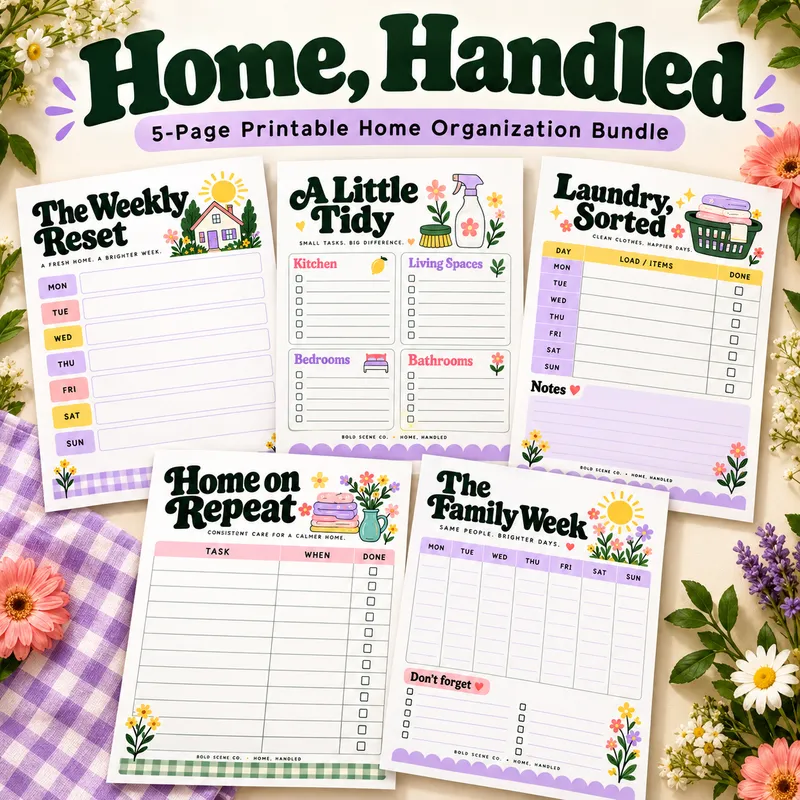
Printable PDF download for personal and family use. No physical item will be shipped. Accessories shown are for display only.
Test the smallest useful version
For the first week, use only a calendar, a shopping list, and an action folder. Notice where information still gets lost. If you keep forgetting items to return, add a departure basket. If appointments are missed because only one adult sees them, improve the shared calendar.
Add sections when a repeated problem calls for them. An unused page creates another place to check, so there is no need to prepare every possible tracker at once.
Keep a low-energy version ready
When family life becomes demanding, reduce the system to the next few days. Check appointments, meals, essential clothing, and anything that needs a response. Put optional projects on a later list.
You can also make ownership easier to see. Write the person’s name beside a job rather than assuming everyone knows who is handling it. A visible list can reduce repeated reminders when the responsibilities are agreed together.
Common questions
Do I need a home binder?
Only if you will use one. A folder and calendar can be enough. Choose the format that makes information easy to find during your ordinary day.
How do I stop creating more lists?
Choose a main home for each type of information. Move useful details there during the weekly review, then clear duplicate notes. If a list does not help you make a decision or complete a task, consider removing it.
What if my partner prefers a different format?
Agree on the information that must be shared and choose a simple common place for it. You can keep personal notes separately as long as shared commitments remain visible to both of you.
A quick visual guide
Give your household a dependable starting point
Begin where details are getting lost. A small system you can return to is easier to maintain as family life changes.
Get the free Sunday Family Reset Checklist to guide your weekly review.